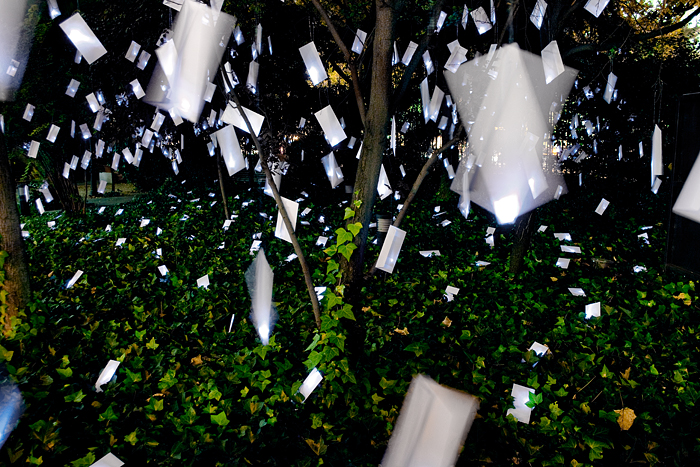
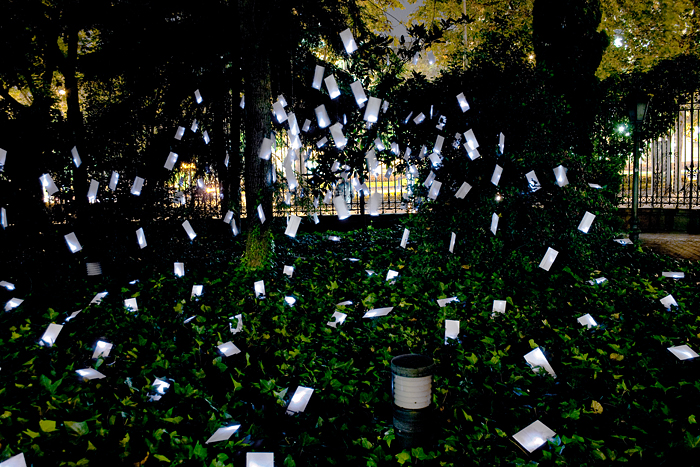
With the installation 1.000 poems by mail, we wanted to illuminate the poetry and at the same time and ensure that the visitors actively enjoyed the installation.
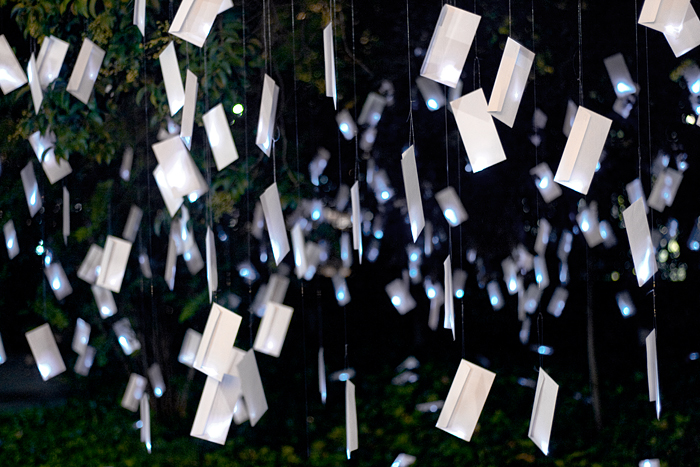
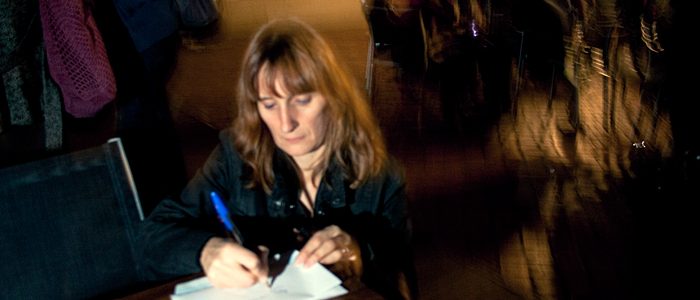
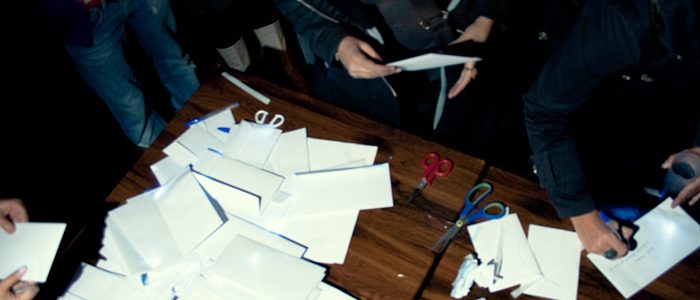
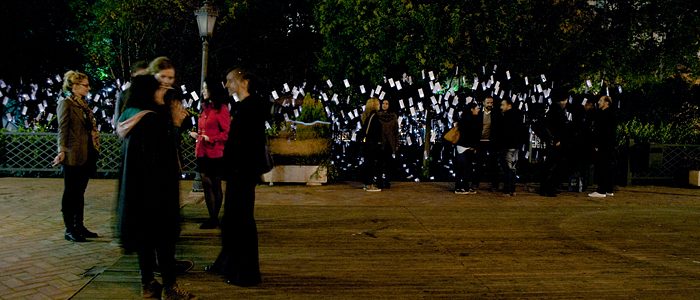
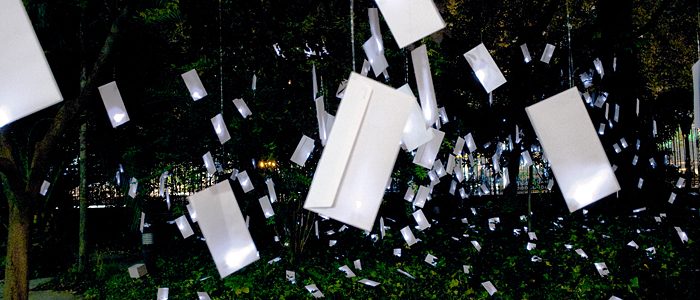
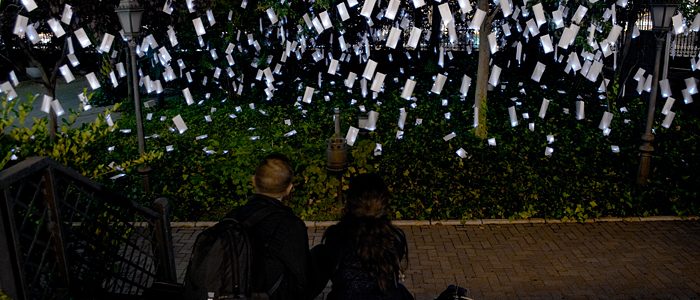
To do this, we filled the garden with 1,000 white envelopes containing poems written especially for the occasion by the poets who participated in the festival.
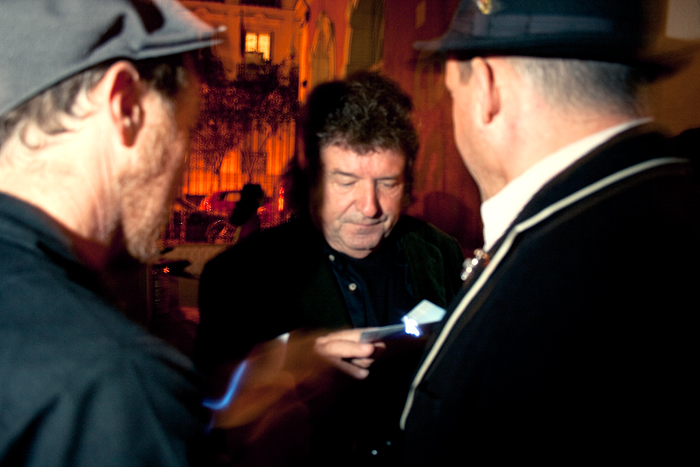
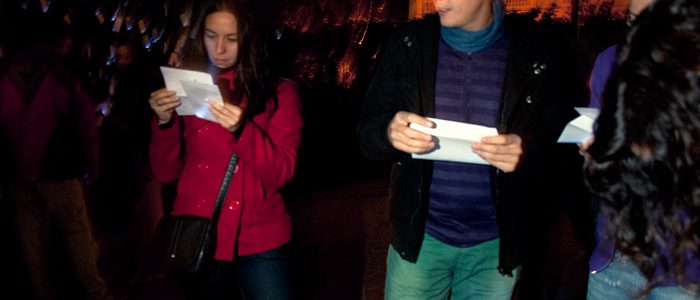
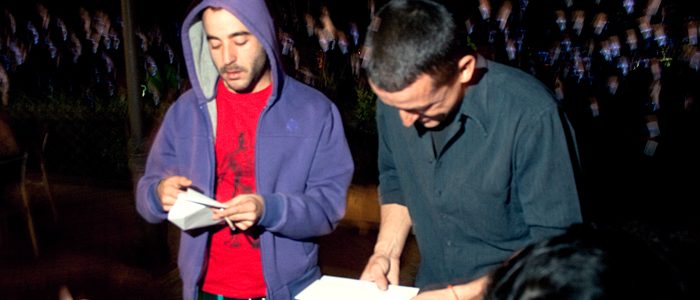
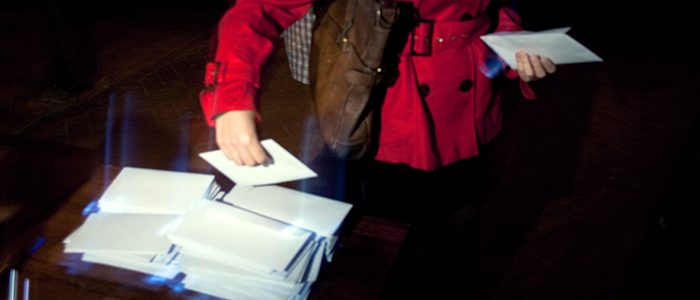
The lit envelopes remained hanging in the garden for 3 days, serving as intimate illumination for the poetic festival. The last night, with light still in the interior, they were offered to the public as keepsakes, or better yet, for them to address to a loved one, to whom we would send the envelope.
With the intervention we wanted to look a little towards the past, in a nostalgic way and remember times in which important words travelled in envelopes.
We also wanted each person that read the poetic message, to think of an important person to whom they would like it to arrive.
We collected about 100 envelopes with addresses which we hurried to send to their recipients. Knowing that the letters arrived still illuminated filled us with joy.
Thanks to the poets, Ajo, Peru Saizprez, Mayra Oyuela, Javier de la Rosa, Javier Nadie, La Más Bella, Raúl Zurita, Julián Herbert, Reynaldo Jiménez, Emila Persola, Héctor Avellán, Linda Wong, Eduardo Scala, Pep Gómez, Maria Eloy-García, Josep Pedrals, Gabriel Vallecillo, for creating a work of art for us to illuminate.
It was a pleasure to work with Pepe and Fabio who made everything so easy for us, and with the team that were voluntarily and diligently installing the 1,000 envelopes with us.
We cannot forget Enrique Morente, who gifted us with his last concert and took an illuminated envelope with him.
Con la instalación 1.000 poesías por correo, quisimos iluminar la poesía y a la vez, que los visitantes disfrutaran de la instalación de manera activa.
Para ello, llenamos el jardín con 1.000 sobres blancos, en su interior poesías escritas especialmente para la ocasión, por los poetas que participaban en el festival.
Los sobres con luz, permanecieron colgados de los árboles durante 3 días, sirviendo de íntima iluminación a las veladas poéticas. La última noche, aun con luz en de su interior, se ofrecieron al público para que los conservara, o mejor, para que escribieran la dirección de un ser querido, al que nosotros haríamos llegar el sobre.
Con la intervención, queríamos mirar un poco hacia atrás, de manera nostálgica y recordar tiempos en los que las palabras importantes, viajaban contenidas en un sobre.
También queríamos que cada persona que leyeran los mensaje poético, tuviera que pensar en esas personas importante a la que le gustaría hacérselo llegar.
Recaudamos unos 100 sobres con direcciones que nos apresuramos a enviar a sus destinatarios. Sabemos que las cartas llegaron aún iluminadas lo que nos lleno de alegría.
Gracias a los poetas, Ajo, Peru Saizprez, Mayra Oyuela, Javier de la Rosa, Javier Nadie, La Más Bella, Raúl Zurita, Julián Herbert, Reynaldo Jiménez, Emila Persola, Héctor Avellán, Linda Wong, Eduardo Scala, Pep Gómez, Maria Eloy-García, Josep Pedrals, Gabriel Vallecillo, por crear para nosotros una obra que iluminar.
Fue un placer trabajar con Pepe y Fabio que nos lo hicieron todo muy fácil, y con el equipo que voluntariamente que diligentemente estuvo instalando con nosotros los 1.000 sobres.
No olvidaremos a Enrique Morente, que nos obsequió con su último concierto y se llevó consigo un sobre iluminado.
With the installation 1.000 poems by mail, we wanted to illuminate the poetry and at the same time and ensure that the visitors actively enjoyed the installation.
To do this, we filled the garden with 1,000 white envelopes containing poems written especially for the occasion by the poets who participated in the festival.
The lit envelopes remained hanging in the garden for 3 days, serving as intimate illumination for the poetic festival. The last night, with light still in the interior, they were offered to the public as keepsakes, or better yet, for them to address to a loved one, to whom we would send the envelope.
With the intervention we wanted to look a little towards the past, in a nostalgic way and remember times in which important words travelled in envelopes.
We also wanted each person that read the poetic message, to think of an important person to whom they would like it to arrive.
We collected about 100 envelopes with addresses which we hurried to send to their recipients. Knowing that the letters arrived still illuminated filled us with joy.
Thanks to the poets, Ajo, Peru Saizprez, Mayra Oyuela, Javier de la Rosa, Javier Nadie, La Más Bella, Raúl Zurita, Julián Herbert, Reynaldo Jiménez, Emila Persola, Héctor Avellán, Linda Wong, Eduardo Scala, Pep Gómez, Maria Eloy-García, Josep Pedrals, Gabriel Vallecillo, for creating a work of art for us to illuminate.
It was a pleasure to work with Pepe and Fabio who made everything so easy for us, and with the team that were voluntarily and diligently installing the 1,000 envelopes with us.
We cannot forget Enrique Morente, who gifted us with his last concert and took an illuminated envelope with him.
id=»BLOGGER_PHOTO_ID_5525803542741215010″ border=»0″ /> Madrid es una ciudad con grandes contradicciones en cuanto a la ocupación de sus espacios públicos y una de las más llamativas es la política que se aplica al consumo de alcohol en la vía pública.
Mientras las plazas se llenan a reventar de terrazas y chiringuitos, en los que despachar alcohol a altos precios está permitido, el consumo de bebidas espirituosas fuera de estos espacios acotados está prohibido.
Pero en el centro, hace ya bastante tiempo que las noches se llenan de un verdadero ejército, bien organizado de vendedores ambulantes, dispuestos a surtir de cerveza a los que no quieren dejar su dinero a los empresarios de la hostelería.
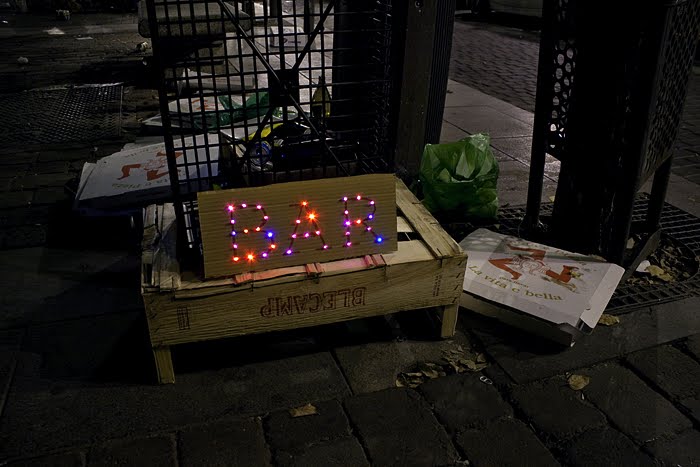
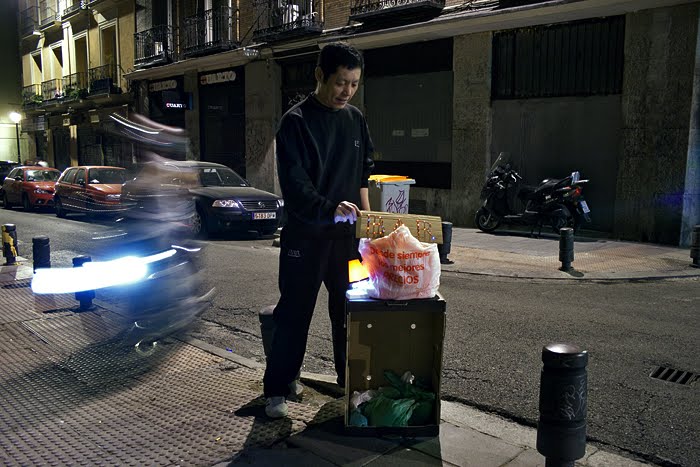
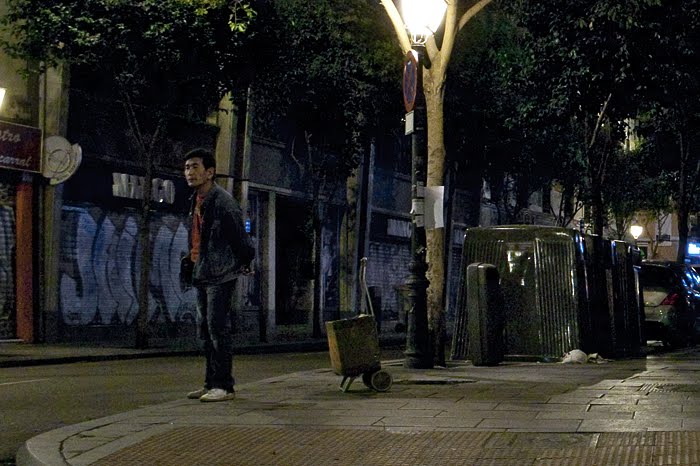
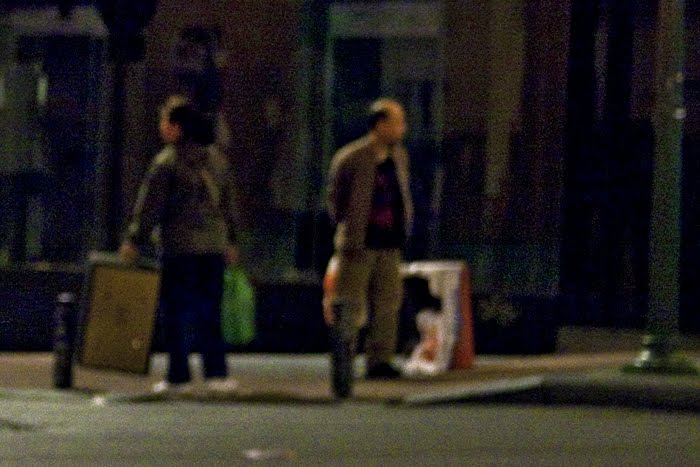
Estos vendedores, se pasan la noche dando vueltas con sus carritos llenos de latas fría o fijos en paradas estratégicas con sus mercancías apoyadas, a modo de barra improvisada, en cajas de fruta recuperadas de la basura.
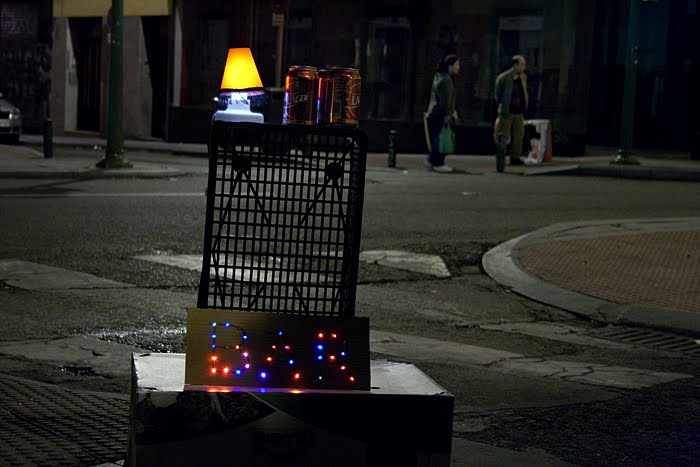
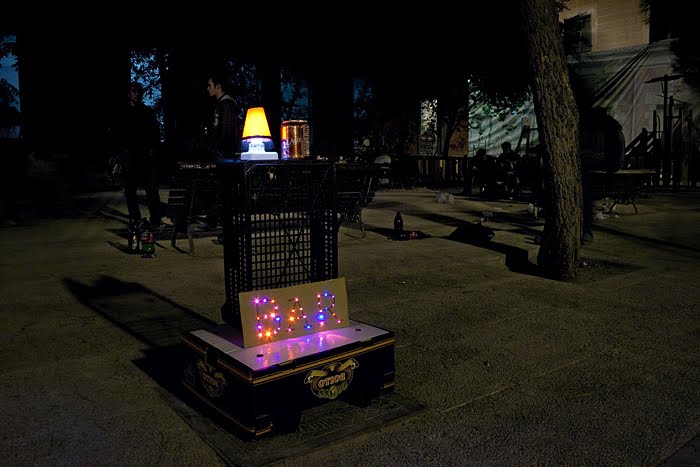
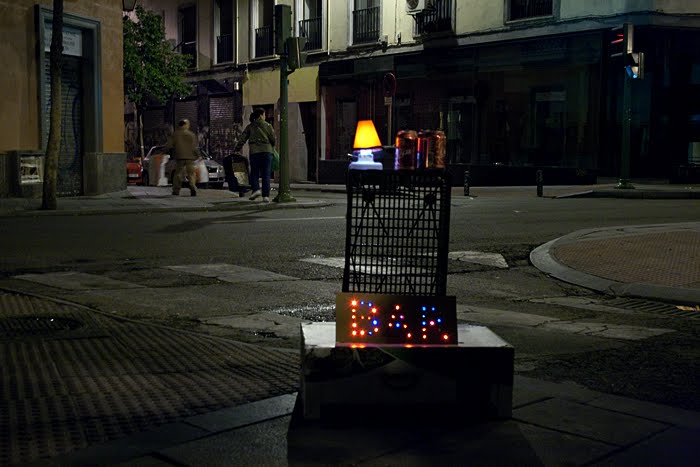
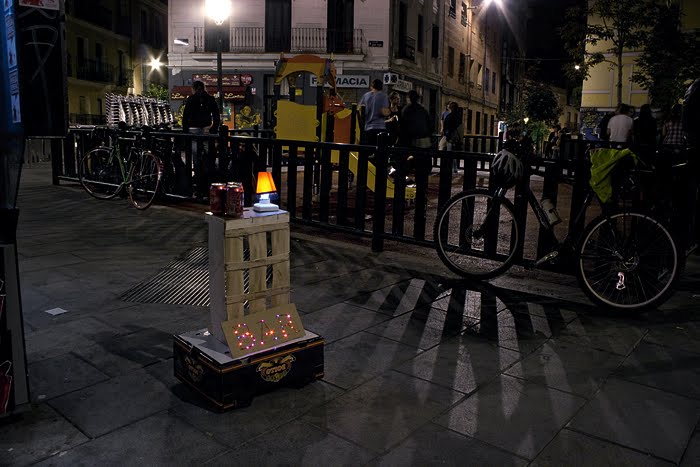
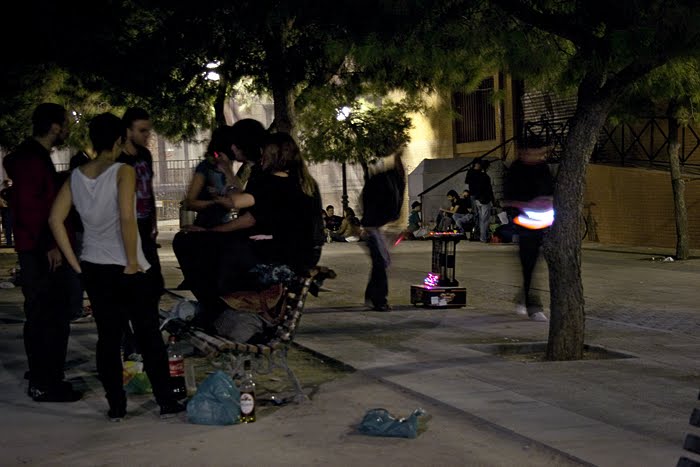
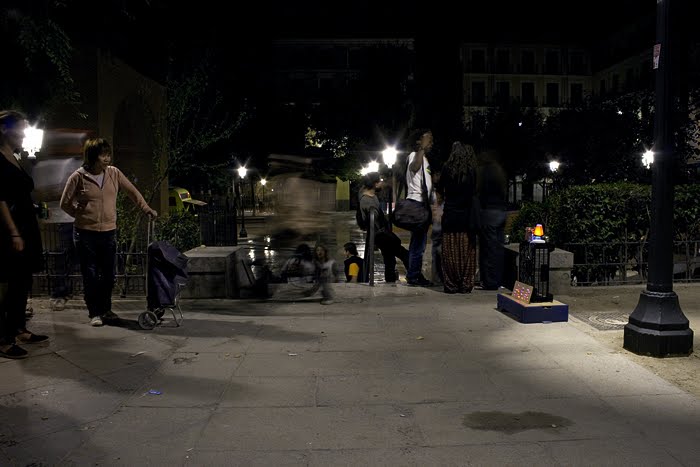
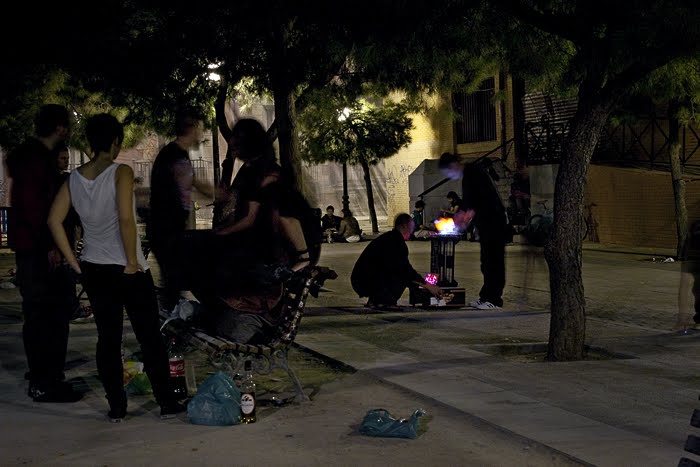
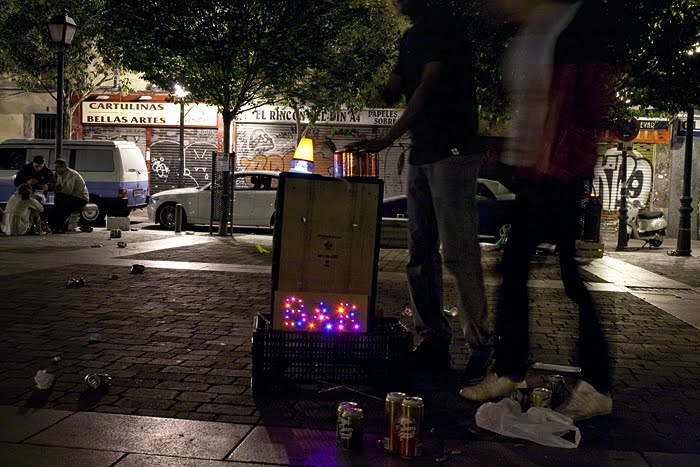
Con nuestra intervención Bares portátiles hemos querido poner un puntito de atención, siempre con humor, a la realidad nocturna de una ciudad, cuyas plazas se convierten en bares improvisados, en los que la cerveza se paga a precios moderados, a cambio de consumirla sentados en el suelo y con el cielo como techo.
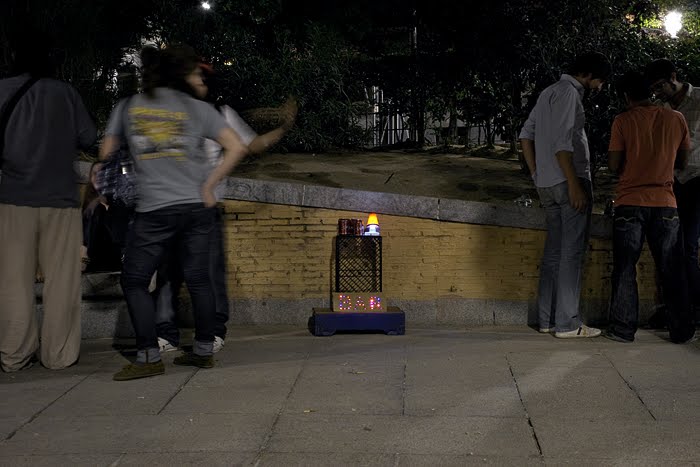
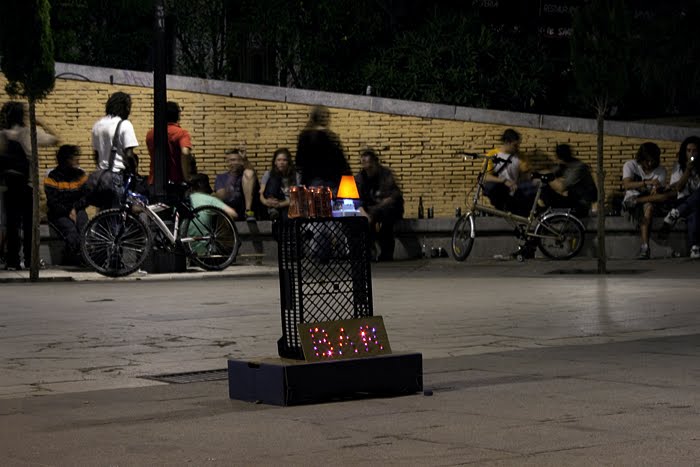
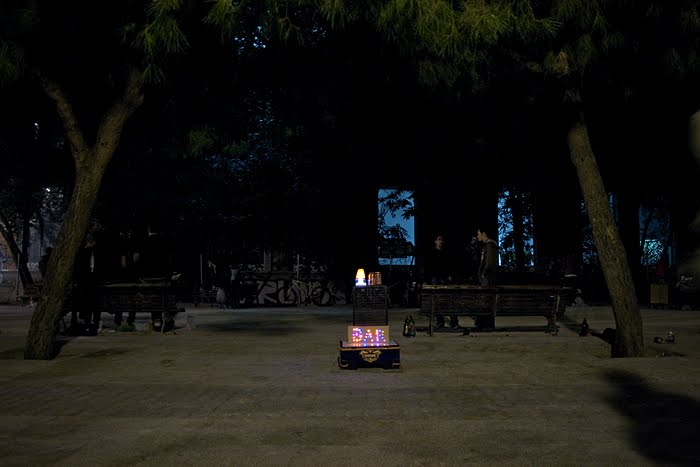
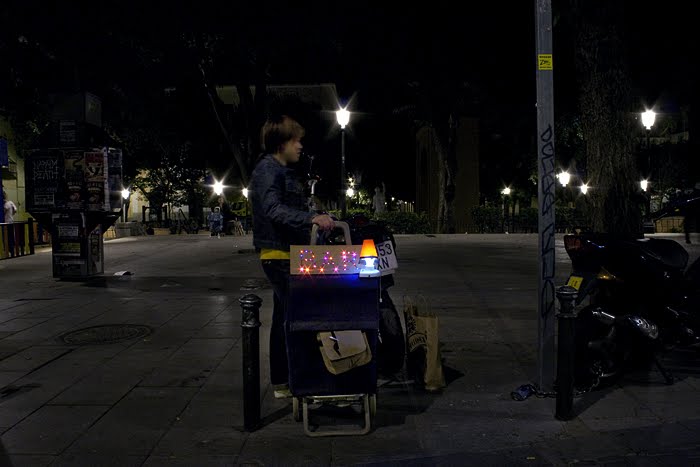
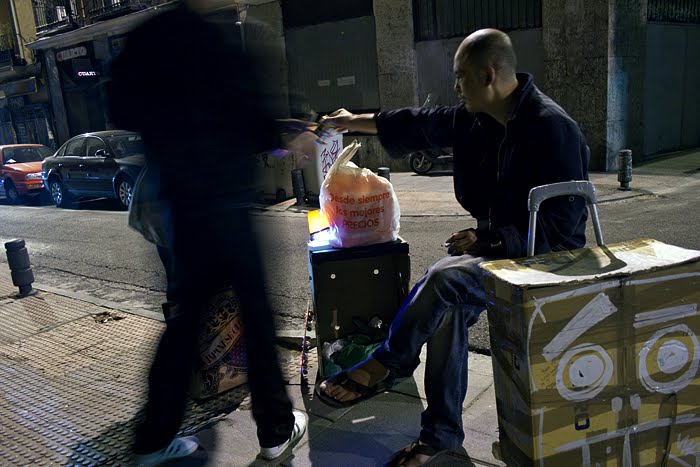
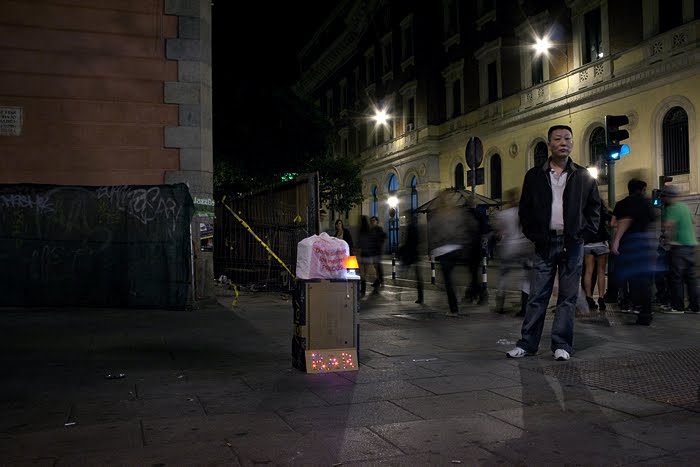
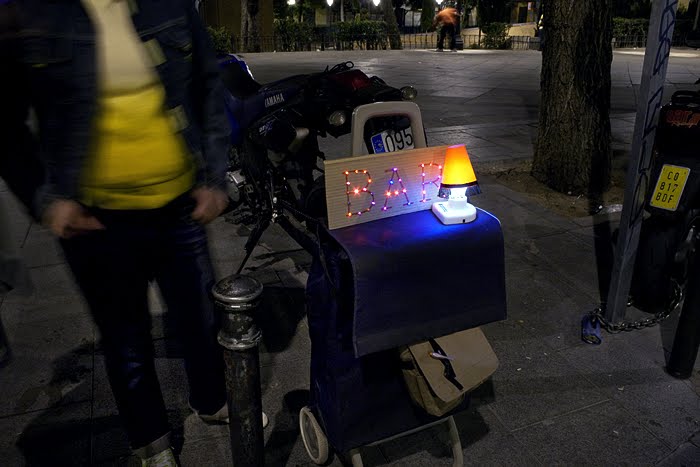
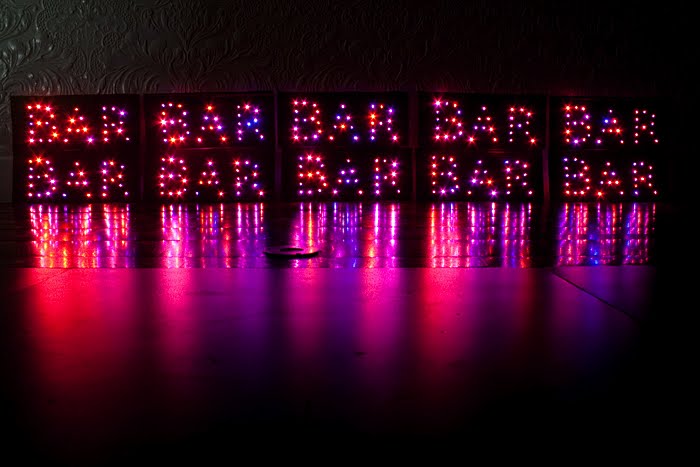
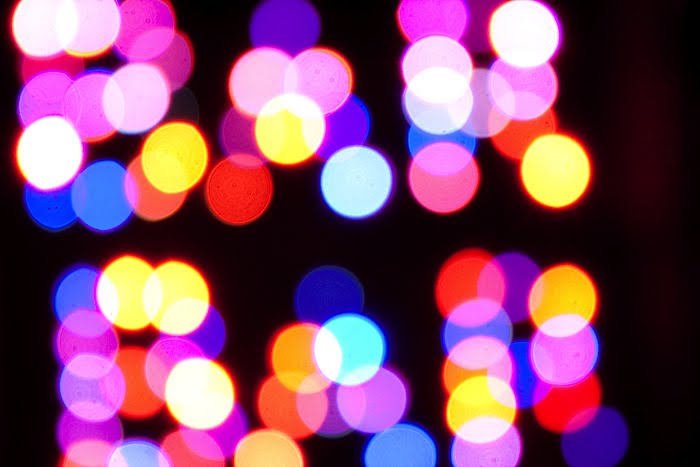
Hemos creado para la ocasión, 10 bares portátiles, imitando la técnica de las cajas de fruta usadas por los chinos, pero hemos querido dotarles de un cierto sentido de permanencia, colocando rótulos luminosos, hechos de cartón reciclado y leds de colores y también de un poquito de «distinción» añadiendo lamparillas rojas, que daban un aire más íntimo al espacio.
Por supuesto, la cerveza no podía faltar, pero nosotros no la vendimos claro, la regalamos a los que las quiseron, que no fueron muchos, ya que estaban algo calientes.
Durante dos noches instalamos nuestros particulares bares en los sitios mas frecuentados por los noctámbulos sedientos y los dejamos para que se familiarizaran con ellos, después tratamos de que los vendedores se los apropiaran o bien para vender en ellos sus propios productos o para que se llevaran los elementos luminosos y los usaran en sus propios puestos y carritos.
Lo conseguimos en la mayoría de los casos, eso sí, después de hablar con ellos un buen rato y de comprarles alguna que otra cerveza…
Ahora se puede decir que conocemos un poco mejor el mundo de los vendedores ambulanes nocturnos, de los consumidores y por supuesto los lugares con mayor interés para reunirse al calor de unas latas bien frías.
Tiempo de montaje: 6 hora Daños ocasionados: 0. Permanencia de la intervención : ¿4 horas?. ———————————————–
Madrid is a city of great contradictions in terms of its use of public spaces, one of the most remarkable being the policy applied to the consumption of alcohol in the street.
While the squares are filled to bursting with patios and open air bars in which the sale of highly priced alcohol is permitted, the consumption of alcoholic drinks outside of these areas is prohibited.
However, the city center at night has been filled by a veritable army of well organized salespeople on foot willing to provide beer to those who don’t want to give their money to the hospitality trade.
These salespeople spend the night walking rounds with their carts full of cans of cold beer or strategically placed with their merchandise displayed, in improvised bar fashion, on fruit boxes recovered from the trash.
With our intervention Portable Bars, we wanted to draw attention, humorously, to the nightlife reality of the city, whose squares are converted into improvised bars, in which beer can be bought at reasonable prices, in exchange for consuming it sitting on the ground under the sky.
For the occasion, we created 10 portable bars, imitating the fruit box technique used by the chinese salespeople, but we wanted to give them a certain sense of permanence, by placing bright placards made of recycled cardboard and colored LEDs and also a little bit of “distinction” by adding red lights which gave a more intimate air to the place.
Of course, they could not be without beer, but we clearly did not sell them, we gave them away to anyone who wanted them, not many did, given that they were already warm.
For two nights we installed our particular bars in the places most frequented by thirsty night owls and left them so that they became familiar with them, after negotiating with the vendors who tried to appropriate them to sell their own products or take the luminous elements to use on their own places or carts.
We achieved this in the majority of the case, after speaking to them for quite a while and buying some more beer for a few of them…
Now we can say that we understand the world of the night time travelling salesperson, of the consumers and of course the most interesting places to get together for a few cold cans of beer in the heat.
Madrid is a city of great contradictions in terms of its use of public spaces, one of the most remarkable being the policy applied to the consumption of alcohol in the street.
While the squares are filled to bursting with patios and open air bars in which the sale of highly priced alcohol is permitted, the consumption of alcoholic drinks outside of these areas is prohibited.
However, the city center at night has been filled by a veritable army of well organized salespeople on foot willing to provide beer to those who don’t want to give their money to the hospitality trade.
These salespeople spend the night walking rounds with their carts full of cans of cold beer or strategically placed with their merchandise displayed, in improvised bar fashion, on fruit boxes recovered from the trash.
With our intervention Portable Bars, we wanted to draw attention, humorously, to the nightlife reality of the city, whose squares are converted into improvised bars, in which beer can be bought at reasonable prices, in exchange for consuming it sitting on the ground under the sky.
For the occasion, we created 10 portable bars, imitating the fruit box technique used by the chinese salespeople, but we wanted to give them a certain sense of permanence, by placing bright placards made of recycled cardboard and colored LEDs and also a little bit of “distinction” by adding red lights which gave a more intimate air to the place.
Of course, they could not be without beer, but we clearly did not sell them, we gave them away to anyone who wanted them, not many did, given that they were already warm.
For two nights we installed our particular bars in the places most frequented by thirsty night owls and left them so that they became familiar with them, after negotiating with the vendors who tried to appropriate them to sell their own products or take the luminous elements to use on their own places or carts.
We achieved this in the majority of the case, after speaking to them for quite a while and buying some more beer for a few of them…
Now we can say that we understand the world of the night time travelling salesperson, of the consumers and of course the most interesting places to get together for a few cold cans of beer in the heat.
Ropa tendida en la ciudad habitada. Así se llama la intervención con luz que presentamos el pasado junio al Festival Madrid Abierto 2009-2010.
Por supuesto no ganamos, más de 600 proyectos y las características «particulares» de este evento lo hacían prácticamente imposible.
Pero el resultado nos gusta y pensamos moverlo en certámenes de iluminación.
El proyecto consistía y consiste en colocar ropa tendida en los espacios públicos, calles principales, grandes avenidas, también en edificios oficiales o abandonados para después iluminarla desde el interior.
La ropa: blanca y básica, camisas, camisetas, pantalones, calcetines, sábanas, ropa interior, trapos, todo limpio, todo expuesto, tendido al sol…
El sistema de iluminación: cables con bombillas de bajo consumo escondidas en la ropa…
La idea: humanizar con ropa, espacios públicos de paso o edificios representativos de la ciudad, para que así parezca que están habitados.
Ahora que estamos en tiempos navideños, una manera barata de iluminar, sin excesivo coste en materiales y consumo energético.
——————————————————————————————————-
Hang clothes in the habited city. This is the name of the project that we presented in June 2008 at Madrid Abierto Festival 2009-2010.
More than 600 projects and the particular characteristics made it didn´t win.
But we liked the result and we intend to present it in other light festivals.
The project consists in hanging clothes in urban public spaces, such as main streets, avenues and also emblematic official buildings and abandoned sites so as to illuminate them from the inside. White and plain clothes: T-shirts, trousers, socks, underwear everything clean and hang under the sun.
The lighting system is designed to use energy saver lamps, inside the clothes.
The idea is to humanize urban spaces and by using ordinary clothes, our intention is to make them look like lived in places.
We also think that at Christmas it would be a good idea to create new lighting sites, cheaply and environment friendly, and to save more energy.